food4future
Food for the future
"No land" and "no trade"
Even today, a rapidly growing world population poses the challenge of ensuring adequate and sufficient nutrition. Resource scarcity, climate change, soil degradation and geopolitical instability are acting as global transformation drivers so that today’s agrosystems will no longer be economically and socially sustainable.
food4future therefore examines two extreme scenarios: “no land” and “no trade”.
Objective of food4future
The long-term goal of this consortium is to ensure healthy nutrition adapted to individual needs for an overall resilient society.
The visions of future agrosystems being developed by food4future takes into account the increasing urbanisation along with the limitation of fresh water and conventional agricultural land. In order to keep value chains and distances short, it strives for sustainable and flexible agricultural production in urban areas, from self-producer-related context to the urban development dimension. Here, the urban production does not compete with the already limited living space. Instead, the usage concepts will take into account vacant areas such as ancillary transport system structures or former industrial facilities.
In addition, biological production systems for model organisms – some of which have received little attention to date – that tolerate saline conditions and, in terms of nutritional physiology, serve as valuable sources of raw materials for innovative food products are being developed in addition.
In the interest of an integrated approach, target groups from food producers to consumers and their nutrition status will be taken into account. The individual supply of nutrients will be ensured through a smart nutrition approach.
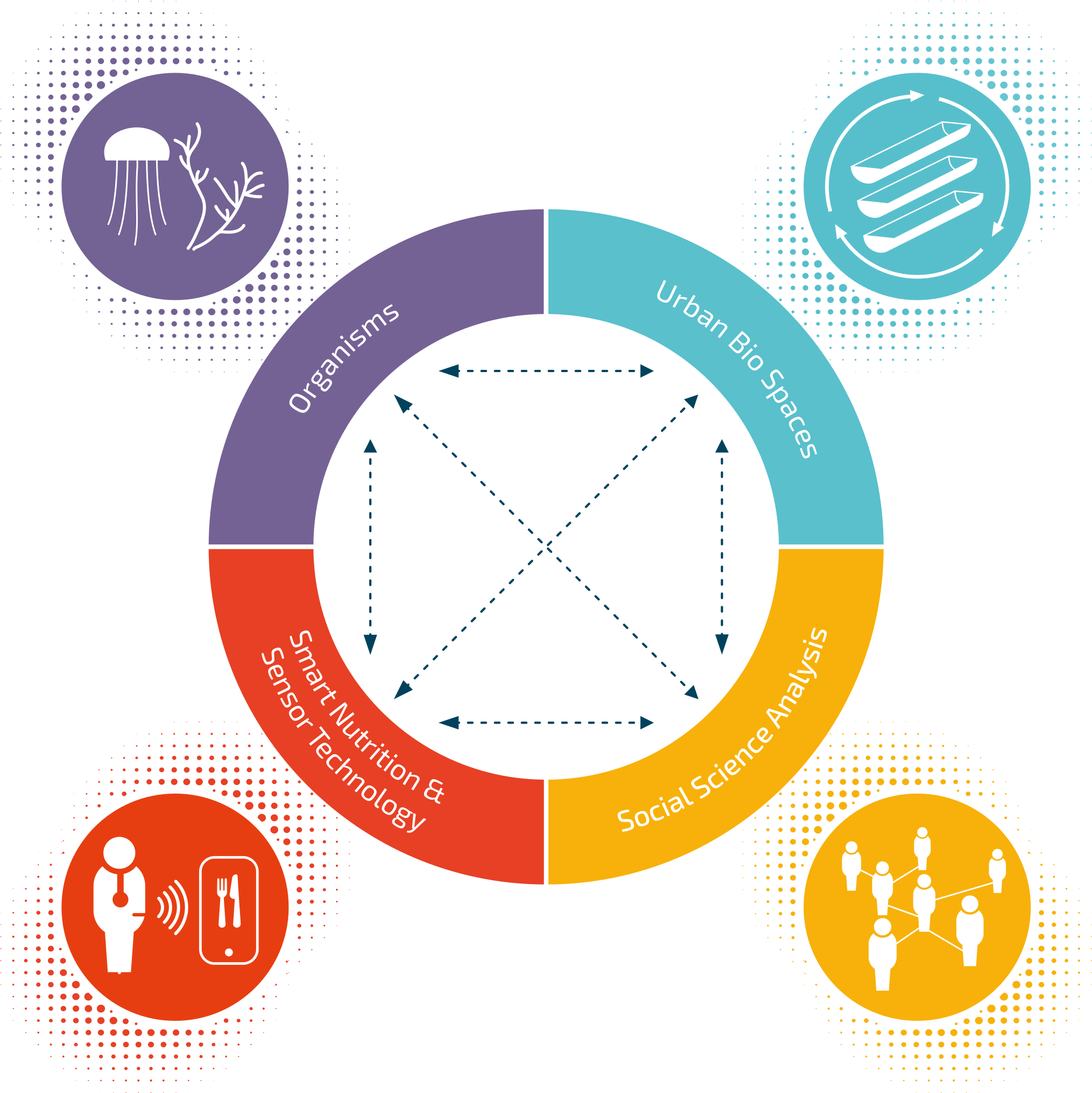
The food4future approach
food4future specifically links key technologies for the establishment of alternative production systems: (UV-)LEDs and innovative composite lightweight materials are being used for the development of modular, multifunctional compartments in an urban environment.
These “Urban-Bio-Spaces” will be used to cultivate four types of organisms in a saline environment as raw material sources for human nutrition. Macro-algae, halophytes (salt-tolerant plants), jellyfish (medusa) and crickets will be cultivated for sustainable biomass production in closed systems, individually or in co-cultivation, with specific optimisation of their nutrient composition by targeted UV-irradiation.
Co-cultivation enables resource conservation through the cascading use of ressources deployed. The individual nutrition status of the consumers will be captured by non-invasive sensors, integrated into a health app using machine learning (artificial intelligence) and linked to demand-driven nutrition suggestions. Moreover, social impact of the two extreme scenarios on the food system will be analysed.
Since extreme change in food production becomes a transformation driver in the interaction of “no land” and “no trade”, food4future also examines endogenously induced changes of the food system and associated social structures, the characteristics of which will further shape nutrition and social interaction.
Coordinator
Prof. Dr. Monika Schreiner
Leibniz Institute of Vegetable and Ornamental Corps (IGZ)
Science Communication
Susann Pophal
Leibniz Institute of Vegetable and Ornamental Corps (IGZ)
Contact
Leibniz Institute of Vegetable and Ornamental Corps (IGZ)
Theodor-Echtermeyer-Weg 1
14979 Großbeeren
Tel.: +49 (0)33701 78-304
E-Mail: vogt@igzev.de
www.food4future.de
Project partners
German Institute of Human Nutrition Potsdam-Rehbruecke (DIfE)
Freie Universität Berlin
Fraunhofer Institute for Applied Polymer Research IAP
Research division Polymeric Materials and Composites PYCO
Humboldt University of Berlin
Leibniz Institute for Agricultural Engineering and Bioeconomy (ATB)
Leibniz Institute of Vegetable and Ornamental Corps (IGZ)
Leibniz Centre for Tropical Marine Research
pmp Projekt Gesellschaft für Projektentwicklung und Generalplanung mbH (pmp)
Technical University of Applied Sciences Wildau
Industry partners
ADM Wild Europe GmbH & Co. KG
InnoMat GmbH
OSRAM Opto Semiconductors GmbH
Panta Rhei gGmbH
TERRA URBANA Umlandentwicklungsgesellschaft mbH